There is a particular kind of invisibility that follows children's design. When we walk through a design museum, we rarely stop at the children's furniture. Our eyes tend to move past it, toward the iconic adult chair, the celebrated lamp, the object that made design history. And yet, some of the most radical, most thoughtful and most human design thinking of the last century was done for the little ones in the room.
We were reminded of this recently, curating our selection for our guided tour at the Designing Childhood exhibition at Design Museum Brussels. We selected six objects, six stories, and a thread running through all of them that feels very close to home.
A Room of Their Own
Alma Siedhoff-Buscher - bench, 1923

In 1923, Alma Siedhoff-Buscher was given the children's room at the Haus am Horn in Weimar, a Bauhaus project that was part design exhibition, part prototype for affordable, functional modern living. The Bauhaus was a progressive school, but women were quietly steered toward weaving. Furniture design belonged to men. The children's room was considered a natural extension of the maternal role, and Siedhoff-Buscher was handed it accordingly.
What she made with that limitation is extraordinary. Her furniture was not scaled-down adult furniture. It was modular and lightweight: a bench that could become a table, a building block, part of a system a child could rearrange entirely on their own. It’s playful yet minimalistic. She did not design objects for children to receive. She designed instruments for them to use. She took a constraint and turned it into an entirely new design discipline.
The First Book of Children's Room Interior Design
Jacques Adnet & Roger Ginsburger - children's room interior prints, 1929

Six years after Siedhoff-Buscher's bench, quieter but equally significant, a publication called Répertoire du Goût Moderne III presented what it described as the first book dedicated entirely to children's room interior design in the modernist style. The original prints in the exhibition come from that book.
The premise was simple but quietly radical: the child's room should not exist in isolation from the rest of the home. Its style, its proportions, its atmosphere should echo the family's interior first, then bend just enough to meet a child's world. Think an adjoining room, a softer corner, or a lower shelf. Because the environment in which a child first becomes aware of the world shapes their early relationship with beauty, with space, with the way things look and feel.

It is an idea that still feels fresh. And it is one that sits at the heart of why we design the way we do.
Fresh Air and Open Walls
Eugène Beaudouin - school chair for the Open-Air School of Suresnes, 1937

Not all children's design happened in the home. In, the Open-Air School of Suresnes opened outside Paris, a building designed entirely around the health and well-being of the child. Classrooms had walls that slid open completely to the outside. The entire school was stairless, connected by ramps. There were easy pathways to bathrooms and medical facilities, nothing that would strain small joints or slow a child down.
Eugène Beaudouin designed a chair for it, a lightweight aluminium seat-and-table unit, easy enough for a child to carry outside when the walls opened and the lesson moved into the air. It is a humble object. But it carries an enormous idea: that the furniture we make for children should follow them, not the other way around.
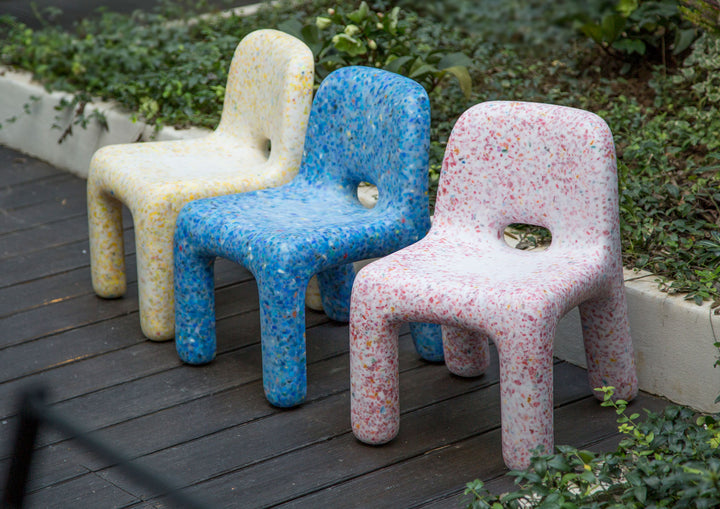
The Charlie Chair was designed with something similar in mind. Its hole, often the first thing people notice, is there so a child can lift it easily, carry it, and make it their own.
A Childrens’ Paradise
Richard Sapper and Marco Zanuso – K1340 chair for Kartell, Italy 1960

On the Belgian coast in Oostduinkerke, a 26-year-old architect named Lucien Engels designed a holiday home for children. Home Emile Vandervelde II was built in three star-shaped wings, a form borrowed from nineteenth-century prison architecture, where the radial plan allowed a single point of oversight. Engels kept the structure and reimagined everything else.
The proportions of the facades were calibrated to a child's body. Every detail such as the door handles, the balustrades, the furniture, the thirty-five metre Jan Cox frescoes on the walls was part of one total vision. A world built entirely around them, down to the chair and table now displayed in the exhibition.
It sadly was demolished in 1996.
A Universe of Your Own
Bruno Munari - Abitacolo, 1971
Abitacolo, meaning the cockpit of an aircraft in Italian, the control room of a spaceship, a habitable space where everything necessary for living is reduced to its minimum. Bruno Munari defined it as something else too: an individual's intimate place to make up their own world.
When most homes are designed entirely around adult needs, Munari designed Abitacolo for children to create their own universe within it. The modular structure, a bed, storage, desk, shelves, could be composed and recomposed. Light but strong. Flexible but considered. Simple but with unlimited possibilities. It asked nothing of the child except that they use it fully.
Where the Circle Closes
ecoBirdy - Charlie Chair, 2018

We did not start with a material. We started with a problem and a question.
Every year, 350 million kilograms of plastic toys are discarded. Ninety percent of them are not recycled. We wanted to know what would happen if they were and if the waste could become something a child would sit in, draw at, grow up alongside.
The Charlie Chair began with the basic shape of a chair and was refined from there, curves adjusted to the dimensions of children's hands, details considered, sitting behaviour studied carefully. The feet are wide enough that the chair is nearly impossible to tip over. And the pattern running across its surface , the speckled texture of Ecothylene®, our own recycled and recyclable material, is not just decoration. It is the story of what the chair is made from, visible to anyone who looks closely enough.
We sort incoming plastic by colour and from that careful, slow process comes a material that is entirely new and entirely second life.
The first time a child notices the pattern and asks where it came from, something begins. A question, a conversation, an early awareness that the things around us have a history and a future. That is the whole point in our opinion.


Read more about
- How much Design do Kids need? Through the Designing Childhood exhibition
- Charlie Chair featured at the Museum of Arts and Design New York
- How ecoBirdy’s Design Process Fosters 'Design Thinking'