Frame Magazine recently published an article exploring the state of children's furniture design. The question at its centre ‘How much design do kids need?’ reflects a broader shift happening across the industry right now.
The market for premium children's furniture is growing rapidly, projected to reach $184 billion by 2030. Brands and designers are responding with more products, more ambition, more investment. But as the article rightly points out, the growth of the market brings with it a deeper question we ask ourselves: are those products truly serving the next generation?

photo credits: @2lgstudio @megantaylorphoto
A cultural moment
This question is not only being asked in boardrooms and design studios. It is being explored in institutions. The Designing Childhood exhibition at Design Museum Brussels, on display until September 2026, charts the history of design for children and the evolving role objects play in a child's development, identity and environment. The exhibition traces how the children's room became a space of its own in the early 20th century, and how designers have responded to each generation's social and cultural challenges ever since.
Today, that challenge includes the environmental crisis. And the design industry is being asked to respond.
We are proud that ecoBirdy is featured in the Designing Childhood exhibition, not only as a furniture brand, but as a reflection of where children's design needs to go.

A social and environmental responsibility
Frame identifies sustainability as one of the defining forces shaping the next wave of children's furniture design. Alongside cognitive development, material safety and functional longevity, it has become a core concern for design-conscious parents. It is no longer a bonus feature. It is an expectation.
And yet, the gap between aspiration and practice remains significant. The furniture and interiors industry continues to rely heavily on raw materials, short product life cycles and linear production models. For a category explicitly designed for children, the generation that will inherit the consequences of today's decisions, that contradiction deserves attention.
How we think about it at ecoBirdy
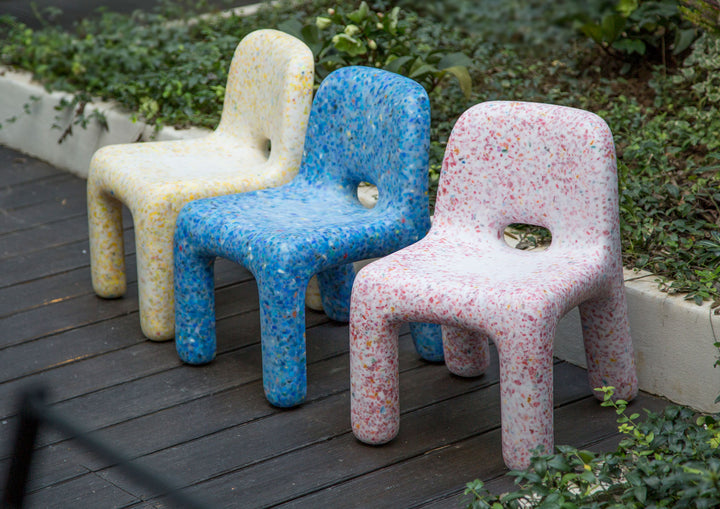
At ecoBirdy, our answer has always been circular. We collect discarded plastic toys, transform them into raw material, and give them a second life as furniture for children. The material carries its history visibly. Every piece is unique because of where it came from. We believe circularity should be seen, not hidden.

Discover more
On June 21st, ecoBirdy will be leading a guided tour through the exhibition at Design Museum Brussels, sharing our own perspective on the evolution of children's design and the story behind the Charlie Chair and Luisa Table.
Register here.

Featured in this story: